If you enjoy relaxing, repetitive crochet projects you can truly make your own, my Selene triangle shawl crochet pattern is a lovely project to unwind with. I designed it during one of those moments when I needed something soothing on my hook — something repetitive, rhythmic, and easy to sink into.
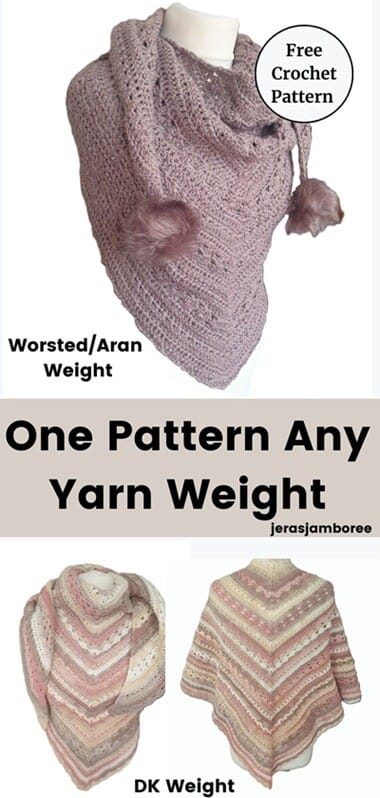
The design works with any yarn weight you already have in your stash — from light 4ply to cosy Worsted — simply choose the matching hook size. I’ve included photos to show Selene worked in both DK and Worsted/Aran yarns. You’ll notice how differently the stitch pattern appears in solid yarn compared to self-striping. Both versions look great but a self-striping yarn highlights the texture and stands out .
A simple 7-row repeat allows you to customise the size completely. Make it small, large, or anything in between to suit your style! In the Measurements section you’ll find a guide for sizes. And if you’re not sure, follow my free pattern instructions for a classic and a large shawl.

You’ll find the full free pattern below so you can start crocheting your Selene Shawl straight away. If you prefer a printable, ad-free version to keep on hand or use offline, you can pick up the PDF in my Etsy and Ravelry shops.
Enjoy my crochet patterns and blog posts?
Add Jera’s Jamboree as a preferred source on Google, Just click below and tick the box to add me.

Jump to: Measurements | Materials | Free Crochet Pattern
Skill Level
Beginner Friendly – increases are made from working 2 extra stitches at the beginning and ending of rows
Measurements
There is no set measurement for this triangle shawl crochet pattern — you can customise the size to suit your personal preference.
Simply repeat the stitch pattern until you reach the wingspan and top-to-tip depth that feels right for you.
To give you an idea of how the shawl grows in different yarn weights:
DK (#3)
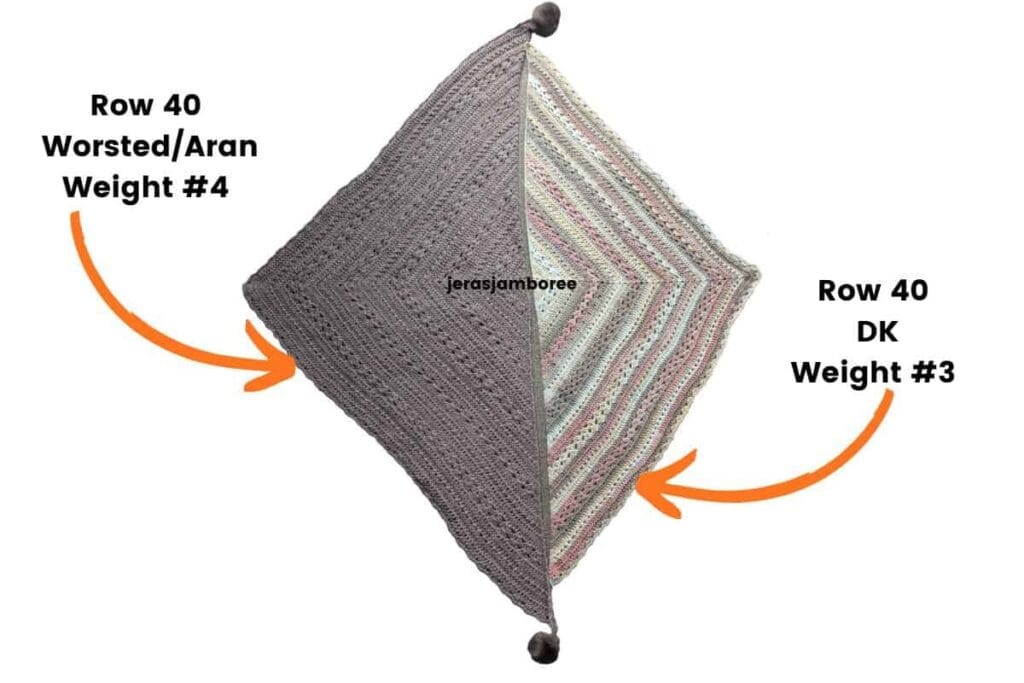
Row 47 (equivalent in size to Worsted/Aran Row 40)
- Wingspan: 59 in
- Top to tip: 25.5 in
This falls within the classic size range.
Row 54
- Wingspan: 69.5 in
- Top to tip: 31 in
This falls within the large size range.
Worsted/Aran (#4)
Row 40
- Wingspan: 59 in
- Top to tip: 25.5 in
This falls within the classic size range.
Size Guide (general triangle shawl ranges)
If you’re choosing your ideal finished size, these ranges may help:
- Small (bandana): ~40–48″ wingspan, 16–20″ top to tip
- Medium (classic): ~60–65″ wingsspan, 22–26″ top to tip
- Large (wrap): ~70–80″ wingspan, 28–34″ top to tip
Top Tip: Try the shawl on as you go. Because the pattern repeats, you can stop increasing at any point once you reach your ideal wingspan and top-to-tip depth.
The image below shows the difference in size between the Worsted/Aran and DK versions when both are worked to Row 40.
Jera’s Jamboree receives payments for affiliate advertising. This is at no extra cost to you. As an Amazon Associate I earn from qualifying purchases. Please see my disclosure policy for more information.
Materials
This triangle shawl crochet pattern can be worked in any yarn weight with the matching hook size.
Below are the yarn amounts and hook sizes used for the sample sizes.
| Yarn Weight | Hook | Finished Size | Yarn Used |
| Worsted/Aran (#4) | 5 mm | 59″ wingspan × 25.5″ top to tip | 670 yards |
| DK (#3) | 4 mm | 59″ wingspan × 25.5″ top to tip | 830 yards |
| DK (#3) | 4 mm | 69.5″ wingspan × 31″ top to tip | 1095 yards |
Yardage will vary depending on yarn weight and how large you make your shawl.
You will also need:
- Tape Measure
- Stitch Markers
- Scissors
- Yarn Needle
- PomPom x 2 – optional (I used these faux fur ones from Amazon)
Yarn Choices
I used yarn from my stash for both the Worsted/Aran and DK samples. Selene is very forgiving, so you can substitute with any yarn that recommends a similar hook size.
One of my favourite things about this stitch pattern is how it transforms depending on the yarn. It feels like a new project every time you change colours or weights!
DK (#3) Weight
For the DK versions, I used James C Brett Aurora in Blush Notes with a 4 mm hook.
This yarn is a soft blend of 20% wool and 80% acrylic, creating a lovely balance of warmth, drape, and stitch definition.
- Ball size: 100 g
- Amount used:
- Classic size: 220 g (approx. 830 yds)
- Large size: 290 g (approx. 1,095 yds)
- Tension: 22 stitches × 28 rows = 10 cm / 4″
- Care: Machine wash 30°C, dry flat
Worsted/Aran (#4) Weight
For the Worsted sample, I used Lion Brand Basic Stitch in Hazelwood with a 5 mm hook.
This yarn is a blend of 65% polyester and 35% Amicor, a fibre designed to offer long-lasting protection against odour, allergens, and bacteria (up to 100 washes).
- Ball size: 100 g
- Amount used: 360 g (approx. 670 yds)
- Tension: 18 stitches × 26 rows = 10 cm / 4″
- Care: Machine wash 30°C, dry flat

Yarn Substitution
You can substitute any yarn weight with its corresponding recommended hook size for this project. My shawl is very flexible, and the drape will vary depending on the yarn you choose.
I thought it would be helpful to share the guide below for how different yarn weights affect your finished shawl.
4ply (Fingering)
Drape: Soft, fluid, and lightweight
How it works up:
- 4ply usually gives the best drape for triangle shawls
- The fabric falls gently and has lots of movement
- Stitches look more delicate and defined
- The shawl will feel light but still warm
- Growth may feel slower because the yarn is finer
Overall:
A 4ply Selene Shawl will feel floaty, elegant, and very drapey, perfect for spring/summer or layering.
DK (#3)
Drape: Soft with gentle movement
How it works up:
- DK gives a balanced drape — not too light, not too firm
- Stitches remain well-defined
- The shawl will feel comfortable and flexible when worn
- Great everyday weight with good coverage without heaviness
Overall:
A DK Selene Shawl will feel soft, wearable, and nicely drapey.
Worsted/Aran (#4)
Drape: Medium drape with some structure
How it works up:
- Creates a fabric with a slightly firmer feel than DK
- Still sits well on the shoulders without feeling stiff
- Stitches look bold and textured
- Adds warmth and body to the shawl
Overall:
A Worsted/Aran Selene Shawl will feel structured yet comfortable, with moderate drape.
Chunky/Bulky (#5)
I wouldn’t recommend using chunky/bulky but I have included it because the choice is yours 🙂
Drape: Structured, thicker, and less fluid
How it works up:
- Chunky yarn creates a much denser, heavier, warmer shawl
- The stitch pattern will appear bolder but less open
- Drape will be firmer — more like a cosy wrap than a flowing shawl
- It works up very fast, but the thickness reduces the natural “flow”
Overall:
A chunky Selene Shawl will feel snuggly and structured, great for warmth, but no drape and will feel stiff.
Comparing the different weight yarns:
- 4ply will give the softest, most fluid drape.
- DK will be soft with lovely movement.
- Worsted/Aran will feel a bit more structured but still wearable with some drape.
- Chunky will produce a thick, warm, more structured shawl with no drape.

Gauge
Gauge is not critical for this project.
Stitches and Abbreviations
You will need to know how to work these stitches:
Special Stitches in this pattern:
V-stitch (V-st): [2dc, ch1, 2dc] in the same stitch.
Iris Stitch: [2dc, ch1, 2dc] in the same stitch. To avoid confusion with the V-stitch, this is written out in full in the pattern.
Crossed Double Crochet (Xdc): Skip a stitch, double crochet in the next stitch, double crochet into skipped stitch working in front of the double crochet just made.
- double crochet (dc)
- slip stitch (sl st)
I have used these common abbreviations in this pattern:
- chain/s (ch/s)
- continue (cont)
- repeat (rep)
- skip (sk)
- space/s (sp/s)
- stitch/es (st/s)

How to Crochet the Triangle Shawl
The Selene Shawl is worked from the centre top and grows outward into a classic triangle shape.
My pattern begins by working into a ring, then the shawl takes shape by increasing at both ends of every row. This creates the gentle, symmetrical widening that gives the shawl its wingspan.
A V-stitch is worked into the centre chain-1 space on every row, forming a decorative spine and guiding the shaping. Alongside the V-stitch, the pattern also uses double crochet, crossed double crochet and the Iris stitch to add texture and interest throughout.
After the foundation rows, the shawl grows through a simple, 7-row repeat (Rows 6–12).
Rows are turned throughout and stitch counts are included making the pattern easy to follow (the PDF version includes a printable row counter).
To customise the size of your shawl, just continue working the row repeats until the wingspan and top to tip measurements suit your preference.
Top Tip: Finishing on Row 5 or Row 6 creates a neat, decorative edge.
Designing Selene reminded me why I love triangle shawls — every few rows you can see the shape unfold in your hands. It’s such a satisfying make.

If you enjoy the stitch repeat used in the Selene Shawl, you might also like these coordinating designs:
- Selene Cardigan
- Selene Sweater
- Selene Hooded Shawl
- Twilight Haven Lap Blanket (uses the same stitch structure in a cosy rectangular design)
My Pattern Notes
- Pattern is written in English using US crochet terms.
- Pattern is in multiples of 3.
- Chain 3 counts as a double crochet.
- The first stitch is the chain 3.
- Row 6 (and repeats) works [2 double crochet, chain 1, 2 double crochet] in the chain 1 spaces of the previous row.
- Note that row 6 works [2 double crochet, chain 2, 2 double crochet] in the centre chain 1 space so that work doesn’t ruffle.
- Row 7 (and repeats) works a double crochet in each double crochet, skipping the chain 1 spaces from Row 6.
- Use a stitch marker for the centre stitch and move up with each row.
- Weave in ends as you go.
Purchase the easy-to-read print-friendly PDF (ad free)
The PDF of this pattern includes everything you need:
- how to work the stitches
- how the pattern is worked
- pattern notes
- clear written instructions
- printable row counter
Selene Triangle Shawl Crochet Pattern (US crochet terms)
Ch3, sl st in the first st to form ring, ch3
Row 1: (WS) 3dc in ring, ch1, 4dc, ch3, turn (8dc, 1 ch1-sp)
Row 2: (RS) 2dc in 1st st, 1dc in ea of next 3 sts, V-St in ch1-sp, 1dc in each of next 3 sts, 3dc in last st, ch3, turn (12dc, 1 V-st)
Row 3: 2dc in 1st st, 1dc in each st to centre ch1-sp, V-st in ch1-sp, 1dc in each st to the last st, 3dc in last st, ch3, turn (20 dc, 1 V-st)
Row 4: 2dc in 1st st, 1dc in each st to centre ch1-sp, V-st in ch1-sp, 1dc in each st to the last st, 3dc in last st, ch3, turn (28 dc, 1 V-st)
Row 5: 2dc in 1st st, sk 3 sts, *[2dc, ch1, 2dc] in next st, sk 3 sts, * rep to centre ch1-sp, [2dc, ch1, 2dc] in ch1-sp, * sk 3 sts, [2dc, ch1, 2dc], * rep to last st, 3dc in last st, ch3, turn (34 dc, 7 ch1-sp)
Row 6: 2dc in 1st st, 1dc in ea of next 2 sts, [2dc, ch1, 2dc] in ea ch1-sp to centre sp, [2dc, ch2, 2dc] in centre ch1-sp, [2dc, ch1, 2dc] to last 3 sts, 1dc in ea of next 2 sts, 3dc in last st, ch3, turn (38 dc, 6 ch1-sp, 1 ch2-sp)
Row 7: 2dc in 1st st, dc in ea dc to centre ch1-sp, V-st in ch2-sp, dc in ea dc to last st, 3dc in last st, ch3, turn (42 dc, 1 V-st)
Row 8: 2dc in 1st st, dc in ea dc to centre ch1-sp, V-st in ch1-sp, dc in ea dc to last st, 3dc in last st, ch3, turn (50 dc, 1 V-st)
Row 9: 2dc in 1st st, Xdc across to centre ch1-sp, V-st in Ch1-sp, Xdc to last st, 3dc in last st, ch3, turn (6dc, 26 Xdc, 1 V-st)
Row 10: 2dc in 1st st, dc in ea st to centre ch1-sp, V-st in ch1-sp, dc in ea st to last st, 3dc in last st, ch3, turn (66 dc, 1 V-st)
Row 11: rep row 10 (74 dc, 1 V-st)
Row 12: 2dc in 1st st, sk 2 sts, [2dc, ch1, 2dc], *sk 3 sts, [2dc, ch1, 2dc], * rep to last 3 sts, sk 2 sts, 3dc in last st, ch3, turn (82 dc, 19 ch1-sp)
Row 13: rep row 6 (86 dc, 18 ch1-sp, 1 ch2-sp)
Row 14: rep row 7 (90 dc, 1 V-st)
Row 15: rep row 8 (98 dc, 1 V-st)
Row 16: rep row 9 (6 dc, 50 Xdc, 1 V-st)
Row 17: rep row 10 (114 dc, 1 V-st)
Row 18: rep row 11 (122 dc, 1 V-st)
Row 19: rep row 12 (130 dc, 31 ch1-sp)
Row 20: rep row 6 (134 dc, 30 ch1-sp, 1 ch2-sp)
Row 21: rep row 7 (138 dc, 1 V-st)
Row 22: rep row 8 (146 dc, 1 V-st)
Row 23: rep row 9 (6 dc, 74 Xdc, 1 V-st)
Row 24: rep row 10 (162 dc, 1 V-st)
Row 25: rep row 11 (170 dc, 1 V-st)
Row 26: rep row 12 (178 dc, 43 ch1-sp)
Row 27: rep row 6 (182 dc, 42 ch1-sp, 1 ch2-sp)
Row 28: rep row 7 (186 dc, 1 V-st)
Row 29: rep row 8 (194 dc, 1 V-st)
Row 30: rep row 9 (6dc, 98 Xdc, 1 V-st)
Row 31: rep row 10 (210 dc, 1 V-st)
Row 32: rep row 11 (218 dc, 1 V-st)
Row 33: rep row 12 (226 dc, 55 ch1-sp)
Row 34: rep row 6 (230 dc, 54 ch1-sp, 1 ch2-sp)
Row 35: rep row 7 (234 dc, 1 V-st)
Row 36: rep row 8 (242 dc, 1 V-st)
Row 37: rep row 9 (6 dc, 122 Xdc, 1 V-st)
Row 38: rep row 10 (258 dc, 1 V-st)
Row 39: rep row 11 (266 dc, 1 V-st)
Row 40: rep row 12 (274 dc, 67 ch1-sp)
Continue rep rows 6 – 12 to your desired size
Stop at row 40 for:
Worsted Weight wingspan 59″ wingspan × 25.5″ top to tip
Row 41 – 47: cont rep rows 6 – 12
Stop at row 47:
DK Weight 59″ wingspan × 25.5″ top to tip
Row 48 – 54: cont rep rows 6 – 12
Stop at row 54:
DK Weight 69.5″ wingspan × 31″ top to tip
Cont reps of rows 6 – 12 until you reach your preferred size
Congratulations, your crochet triangle shawl is finished and ready to be blocked and worn (or gifted!).
I hope you enjoy making your crochet triangle shawl as much as I enjoyed designing it. Whether you’re using 4ply, DK or Worsted/Aran, this is one of those projects that’s relaxing to work on and so satisfying to wear.
If you’re looking for more inspiration, you might enjoy these free patterns:
- Meadowsong Lightweight Scarf
- Crochet Shawl Patterns
- Free Crochet Shawl Patterns You’ll Want to Make Next
- One Skein Crochet Shawl Patterns
I’d love to see your Selene Shawl — feel free to share your photos on social media or in my crochet community on Facebook.
Love discovering new crochet patterns? My newsletter is the best way to hear about new releases, free patterns, and helpful resources — all delivered straight to your inbox. You can join the mailing list for free right here.
Thank you for being here and sharing this creative space with me — it means more than you know.
Copyright Notice
The pattern and photographs of this design are the property of Sharon Goodwin at Jera’s Jamboree. This pattern and design are subject to copyright and are for personal, non-commercial use only. You may not share, resell, alter or redistribute this pattern in part or in whole. You may, however, sell any finished items you make. If you would like to include this pattern in a roundup, you may take one photo and link back to this pattern.
Save the pin below to your favourite board to come back to when you’re ready.

Very pretty.
Thank you Diane